

Future-Proofing Your Cabling Infrastructure for the Next Decade
Avoid costly overhauls | Ensure uptime and maintainability
Future-Proofing Your Cabling Infrastructure for the Next Decade
Introduction: Build for the Future, Not Just for Today
This guide explains how to future-proof your cabling infrastructure for at least ten years. By doing so, you can avoid costly rip-and-replace cycles and build a foundation that grows with you.
In a world of ever-increasing bandwidth demands, emerging technologies like AI, IoT, machine vision, and 5G edge computing are pushing infrastructure to its limits. Your cabling system can’t just “work today.” It needs to be resilient, extensible, and ready to scale.
Why Future-Proofing Your Cabling Infrastructure Matters
- Avoid costly overhauls: Rewiring cabling systems later is disruptive and expensive.
- Support emerging standards: Ethernet speeds, PoE power classes, and fiber technologies are evolving rapidly.
- Ensure uptime and maintainability: A structured, documented system is easier to manage, troubleshoot, and expand.
- Protect ROI: The right infrastructure today supports your growth tomorrow.
Panduit’s research shows that structured cabling enables performance stability even as AI, IoT, and edge technologies drive data density higher. It’s not speculation to future-proof your cabling infrastructure; it’s essential design.
1. Design Around Structured Cabling Foundations
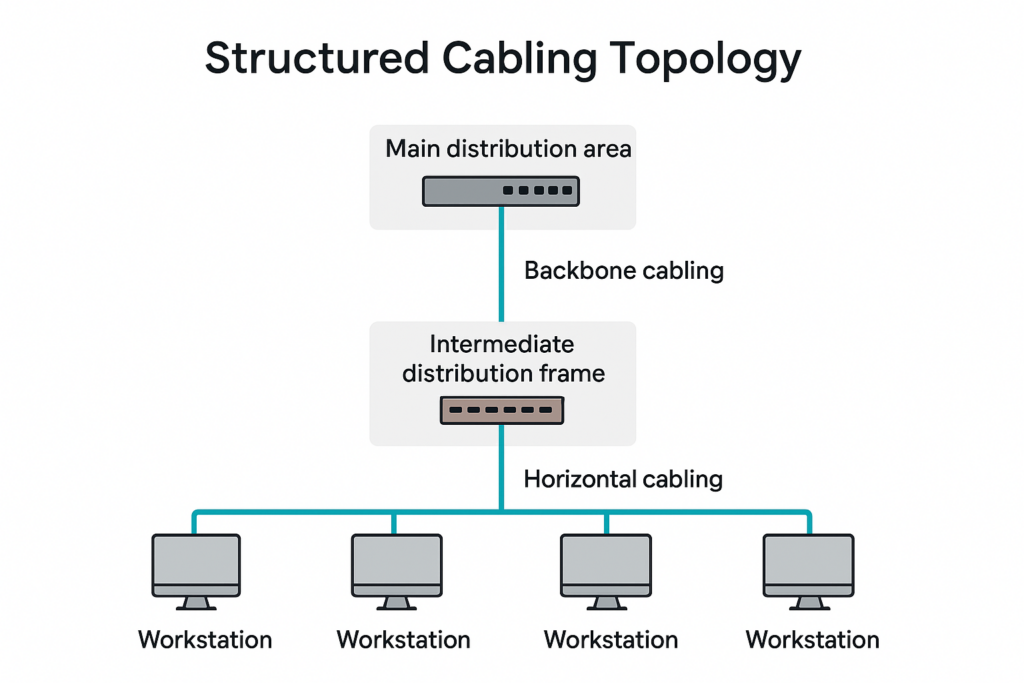
A structured cabling framework organizes your network into backbone, horizontal, and work-area subsystems. By aggregating patch panels, conduits, and jacks in a modular, repeatable layout, you gain consistency, scalability, and manageability.
Panduit’s AI Network Performance Testing White Paper demonstrates that structured cabling supports large-scale, high-density networks with better latency, easier maintenance, and simplified growth compared to point-to-point connections. This approach forms the backbone of modern, high-performance infrastructure.
Practical takeaway: Build with modularity in mind so each segment can be serviced or upgraded without disrupting the entire system.
2. Use High-Grade Media: Copper + Fiber Hybrid Approach
Copper Cabling: Cat6A as the Sweet Spot
Category 6A remains the practical choice for most modern deployments. It supports 10 Gbps over 100 meters and meets the higher thermal and signal-integrity demands of advanced PoE (IEEE 802.3bt).
Panduit’s Wi-Fi 5/6/7 Infrastructure White Paper recommends installing a minimum of two Cat6A cables per access point, and up to four for redundancy and bandwidth headroom. This ensures capacity for future wireless generations and power delivery standards.
Avoid relying on older Cat5e, which lacks headroom for 10 Gbps and higher-power PoE loads.
Fiber Optics: Plan for Backbone Scalability
Use single-mode or multimode fiber for your backbone connections, especially between telecom rooms or buildings. Include extra strands or micro-ducts for future expansion.
Panduit’s testing for AI-ready infrastructure shows that structured fiber systems can scale from 10 Gb to 400 Gb and beyond to 800 Gb while maintaining low latency and low bit error rates.
Practical tip: Always leave un-terminated fiber spares and label them for “Future Use.”
3. Plan for Scalability and Growth
Future-proofing your cabling infrastructure isn’t just about faster cable; it’s about room to grow.
- Overprovision pathways and conduits, leaving empty ducts and trays for future cable runs.
- Leave spare fibers and pairs; don’t terminate everything on day one.
- Use modular enclosures and racks that expand as your needs grow.
- Select flexible topologies that fit your operational model, such as end-of-row, middle-of-row, or top-of-rack layouts.
Panduit emphasizes designing for move/add/change efficiency, which reduces downtime and labor costs during expansion.
4. Cable Routing, Pathways & Management
Effective routing preserves performance and simplifies maintenance:
- Maintain proper bend radius and avoid sharp turns.
- Separate power and data lines to prevent electromagnetic interference.
- Use ladder racks, vertical managers, and color-coded pathways for clarity.
- Maintain airflow clearance to prevent heat buildup.
- Label both ends of every cable and update documentation after any change.
Panduit’s RapidID solutions streamline labeling and verification, improving long-term reliability and serviceability.
5. Adhere to Standards & Documentation for Cabling Infrastructure
- Follow ANSI/TIA-568 and ISO/IEC 11801 standards for cabling, pathways, and connectors.
- Maintain as-built drawings, labeling charts, and certification reports.
- Test and certify all copper and fiber runs to validate performance.
- Schedule periodic inspections to detect wear or damage early.
Panduit highlights that accurate documentation is an investment in uptime. Their RapidID platform automates recordkeeping and reduces errors during troubleshooting and upgrades.
6. Future Trends in Cabling Infrastructure & Considerations
As technology continues to advance at a rapid pace, network infrastructure must be designed not only to meet today’s demands but also to accommodate the innovations of tomorrow. Considering future trends ensures your cabling system remains reliable, scalable, and capable of supporting emerging applications and higher performance requirements.
- Plan for higher speeds and densities, including 25 Gb, 40 Gb, and 100 Gb uplinks.
- Prepare for evolving PoE standards like IEEE 802.3bt (Type 3 and 4) delivering up to 90 watts.
- Improved shielding: Cat6A and higher categories reduce alien crosstalk.
- Smart infrastructure: Intelligent patch panels and software-defined connectivity are becoming common.
- Sustainability: Low-smoke, halogen-free, and recyclable materials are increasingly standard.
Panduit’s fiber and PoE research confirms that proactive cable choices deliver measurable long-term ROI.
Panduit’s fiber and PoE research confirms that proactive cable choices deliver measurable long-term ROI.
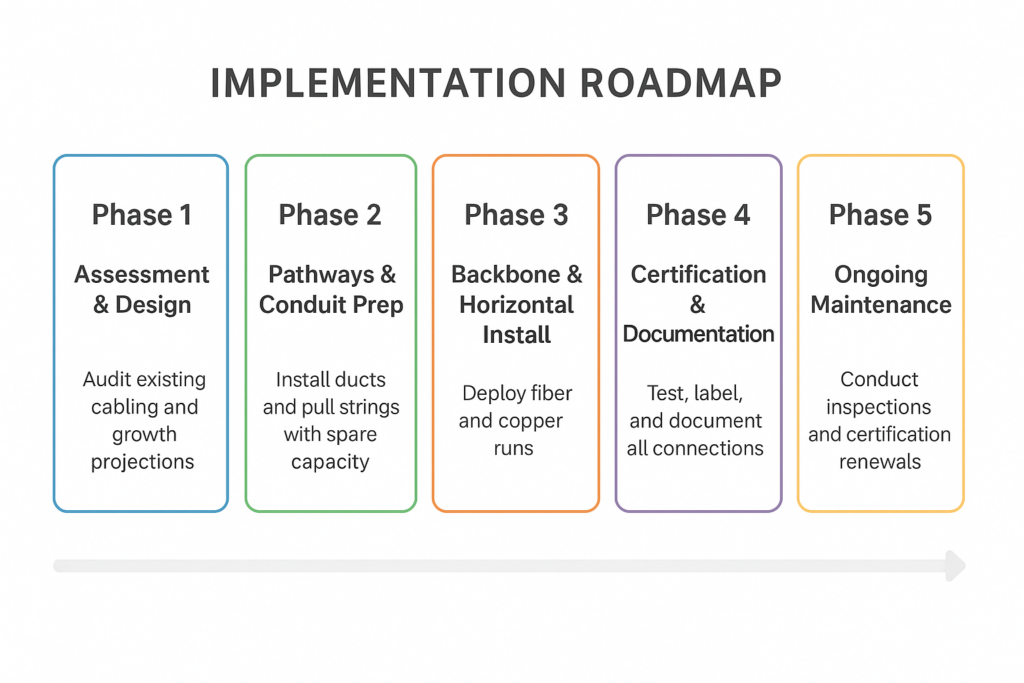
7. Implementation Roadmap: A Phased Approach to Cabling Infrastructure
| Phase | Focus | Key Actions |
|---|---|---|
| Phase 1 | Assessment & Design | Audit existing cabling and growth projections. |
| Phase 2 | Pathways & Conduit Prep | Install ducts and pull strings with spare capacity. |
| Phase 3 | Backbone & Horizontal Install | Deploy fiber and copper runs. |
| Phase 4 | Certification & Documentation | Test, label, and document all connections. |
| Phase 5 | Ongoing Maintenance | Conduct inspections and certification renewals. |
8. Common Pitfalls to Avoid
Even with careful planning, organizations can encounter common mistakes that undermine long-term network performance. Being aware of these pitfalls helps ensure that your cabling infrastructure remains reliable, scalable, and easy to maintain over time.
- Underestimating future bandwidth needs.
- Ignoring slack or spare capacity.
- Poor labeling and documentation.
- Overcrowded conduits.
- Mixing incompatible cable types or shielding levels.
Conclusion: Invest Once, Adapt for Decades
Future-proofing your cabling infrastructure is a strategic decision that determines how well your organization can adapt to new technologies.
By designing around structured cabling, using high-grade materials, and maintaining thorough documentation, you create a system that grows with your needs.
Panduit’s testing proves that structured cabling provides flexibility and long-term value.
Partner with Newport Network Solutions Inc. for real-world application of these best practices. Contact us for a site audit or structured cabling consultation.
Why Newport Network Solutions Stands Out in Wisconsin
With Newport Network Solutions, you’re not just hiring a subcontractor—you’re gaining a Division 27 & 28 partner who understands:
- The full construction lifecycle
- Code compliance and testing
- Scope coordination with other trades
- Owner turnover requirements and expectations
Based in New Berlin WI with an office in Madison, WI:
🌐 Visit us online:
🔗 Connect on LinkedIn:
linkedin.com/company/newport-network-solutions
📞 Contact us today to review your project or request a quote:
Adrian Crabb – Business Development Manager
Phone: 608-572-2654
Email: adrian@newportnetworksolutions.com
Ready to elevate your Milwaukee or Madison project?
Contact Newport Network Solutions today to discuss your data cabling installation, commercial surveillance systems, or other needs.
Visit newportnewtorksolutions.com or call 608-572-2654 (Madison) or 414-453-8099 (Milwaukee) to get started.
Contact: Adrian Crabb, Business Development Manager
Email: adrian@newportnetworksolutions.com
Serving the Greater Milwaukee Area (Waukesha, Brookfield, Wauwatosa), Greater Madison Area (Fitchburg, Middleton, Sun Prairie, McFarland, Stoughton, Waunakee, Dane County), Northern Illinois.
Newport Network Solutions, Inc. | Your Local Expert for Network Cabling, Security, and Audiovisual Solutions in Milwaukee and Madison, WI
GET A QUOTE
"*" indicates required fields