

Structured Cabling Code Compliance and Labeling Best Practices
A Complete Guide for Commercial Installations
Structured Cabling Code Compliance and Labeling Best Practices
In today’s complex commercial environments, structured cabling code compliance and labeling best practices are essential components of a reliable telecommunications infrastructure. Whether implementing fiber backbone or copper horizontal cabling, following code and labeling standards isn’t optional. Rather, it’s foundational to performance, safety, and long-term maintainability.
As the final post in our four-part structured cabling series, this article explains why compliance and labeling matter, how they affect inspections and network operations, and why working with a qualified installer is critical. That’s especially true under Wisconsin’s updated Commercial Building Code.
Why Structured Cabling Code Compliance Matters
Structured cabling systems must conform to multiple overlapping standards and codes, including:
- ANSI/TIA-568 series – Commercial building telecommunications cabling standards
(Telecommunications Industry Association) - ANSI/TIA-606-C – Administration and labeling of telecommunications infrastructure
(BradyID overview of TIA-606-C) - National Electrical Code (NEC) – Including Articles 725 and 800 governing low-voltage and communications cabling
(NFPA NEC) - Wisconsin Commercial Building Code – Administered by the Department of Safety and Professional Services (DSPS)
(Wisconsin DSPS)
These standards collectively define how cabling is routed, supported, fire-rated, labeled, and documented.
Legal and Safety Compliance
It’s true that meeting code helps builders pass inspection. But really it’s about planning for long-term system reliability. In Wisconsin, structured cabling must comply with state Commercial Building Code requirements, NEC standards, and fire safety regulations enforced by DSPS. Using proper fire-rated cabling and consistent labeling practices helps ensure networks are safe, serviceable, and easy to maintain. According to Wisconsin’s updated Commercial Building Code, compliant installations reduce troubleshooting time, simplify future upgrades, and help facilities teams avoid operational disruptions caused by inspection failures or undocumented cabling. However, not following code inevitably leads to problems down the road.
Failure to meet these requirements can result in failed inspections, costly remediation, project delays, voided insurance, or denied occupancy approvals. When cabling is installed without proper planning or oversight, these risks increase significantly.
Performance, Interference Control, and Reliability
Proper separation of low-voltage cabling from power circuits, correct grounding, and adherence to bend radius and pathway fill requirements all contribute to consistent network performance. Code-compliant installations reduce electromagnetic interference (EMI), prevent physical cable damage, and improve overall system reliability. Yet, in order to get favorable results, technicians need to know structured cabling best practices.
What Are Labeling Best Practices?
Labeling is a core component of structured cabling code compliance and labeling best practices. A well-designed labeling scheme ensures structured cabling systems remain usable long after installation.
Follow ANSI/TIA-606-C Labeling Standards
According to ANSI/TIA-606-C, labeling should:
- Be machine-generated (handwritten labels are not acceptable)
- Be legible, durable, and resistant to fading or smudging
- Appear at both ends of each cable
- Identify outlets, patch panels, racks, and pathways consistently
A standardized label typically includes the building, telecom room, rack, panel, and port number, creating a clear roadmap for technicians. But it’s not only about the technician installing today.
A typical label references the building, telecommunications room, rack, panel, and port. This allow any technician that needs to service or add cabling in the future to quickly understand cable routing without guesswork.
(Cabling Installation & Maintenance – Labeling Best Practices)
Why Labeling Matters in Real Operations
Proper labeling dramatically reduces troubleshooting time, prevents accidental disconnections, simplifies inspections, and makes future upgrades predictable. For IT and facilities teams, a labeled infrastructure eliminates guesswork and dependence on institutional knowledge.
Benefits of Structured Cabling Code Compliance and Labeling Best Practices
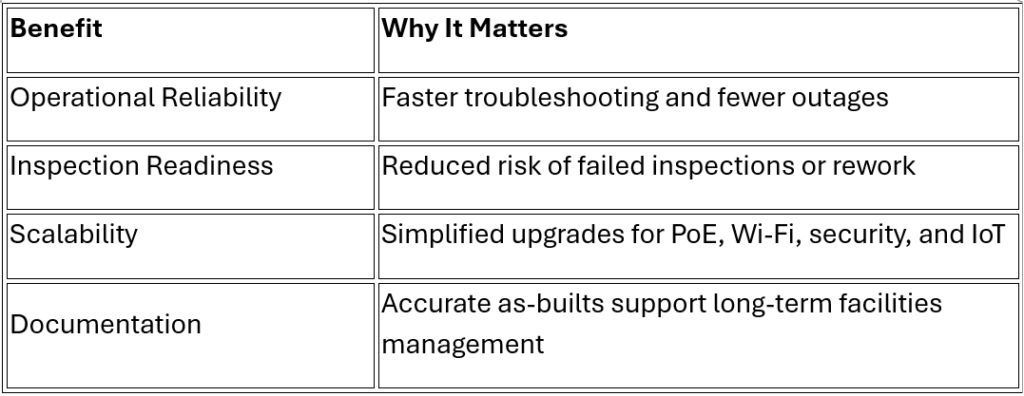
For additional background on standards-driven design, see our earlier post on Structured Cabling Standards and MDF Design.
Real-World Scenario: Wisconsin Commercial Office Build-Out
Imagine a 50,000 sq ft office build-out. The contractor pulled Cat6A and fiber for data, VoIP, security, and Wi-Fi systems. During the city’s final low-voltage inspection, the inspector found:
- Data cabling installed above a suspended ceiling in a return-air plenum was not CMP-rated
- Cable labeling did not match submitted documentation
- Firestopping at several pathway penetrations was incomplete
Although the network functioned properly, the installation failed inspection under Wisconsin’s Commercial Building Code. The result was delayed occupancy, unplanned rework, and additional coordination between trades.
Contrast that with a project that implemented Wisconsin-compliant fire-rated cabling, consistent labeling aligned with ANSI/TIA-606-C, and accurate as-built documentation. That installation sailed through inspection and simplified future network upgrades including VoIP expansion and wireless upgrades.
Why Hiring a Competent Structured Cabling Installer Matters
Experienced structured cabling installers understand applicable codes, standards, and local inspection practices. They design systems that comply with current requirements while anticipating future needs.
Competent installers also provide accurate labeling, testing documentation, and as-built drawings, all of which reduce risk during inspections and future renovations. Shortcuts during installation often remain hidden until failures occur or systems need to be expanded.
Conclusion
Structured cabling code compliance and labeling best practices are fundamental to safe, reliable, and scalable commercial networks. By following established standards and working with qualified professionals, organizations reduce risk, improve system performance, and ensure long-term usability.
If you are planning a new installation or upgrading an existing facility, partnering with an experienced structured cabling provider helps ensure your infrastructure remains an asset — not a liability.
Newport Network Solutions delivers structured cabling solutions designed to meet code requirements while supporting the evolving needs of modern commercial environments.
Why Newport Network Solutions Stands Out in Wisconsin
With Newport Network Solutions, you’re not just hiring a subcontractor—you’re gaining a Division 27 & 28 partner who understands:
- The full construction lifecycle
- Code compliance and testing
- Scope coordination with other trades
- Owner turnover requirements and expectations
Based in New Berlin WI with an office in Madison, WI:
🌐 Visit us online:
🔗 Connect on LinkedIn:
linkedin.com/company/newport-network-solutions
📞 Contact us today to review your project or request a quote:
Adrian Crabb – Business Development Manager
Phone: 608-572-2654
Email: adrian@newportnetworksolutions.com
Ready to elevate your Milwaukee or Madison project?
Contact Newport Network Solutions today to discuss your data cabling installation, commercial surveillance systems, or other needs.
Visit newportnewtorksolutions.com or call 608-572-2654 (Madison) or 414-453-8099 (Milwaukee) to get started.
Contact: Adrian Crabb, Business Development Manager
Email: adrian@newportnetworksolutions.com
Serving the Greater Milwaukee Area (Waukesha, Brookfield, Wauwatosa), Greater Madison Area (Fitchburg, Middleton, Sun Prairie, McFarland, Stoughton, Waunakee, Dane County), Northern Illinois.
Newport Network Solutions, Inc. | Your Local Expert for Network Cabling, Security, and Audiovisual Solutions in Milwaukee and Madison, WI
GET A QUOTE
"*" indicates required fields