
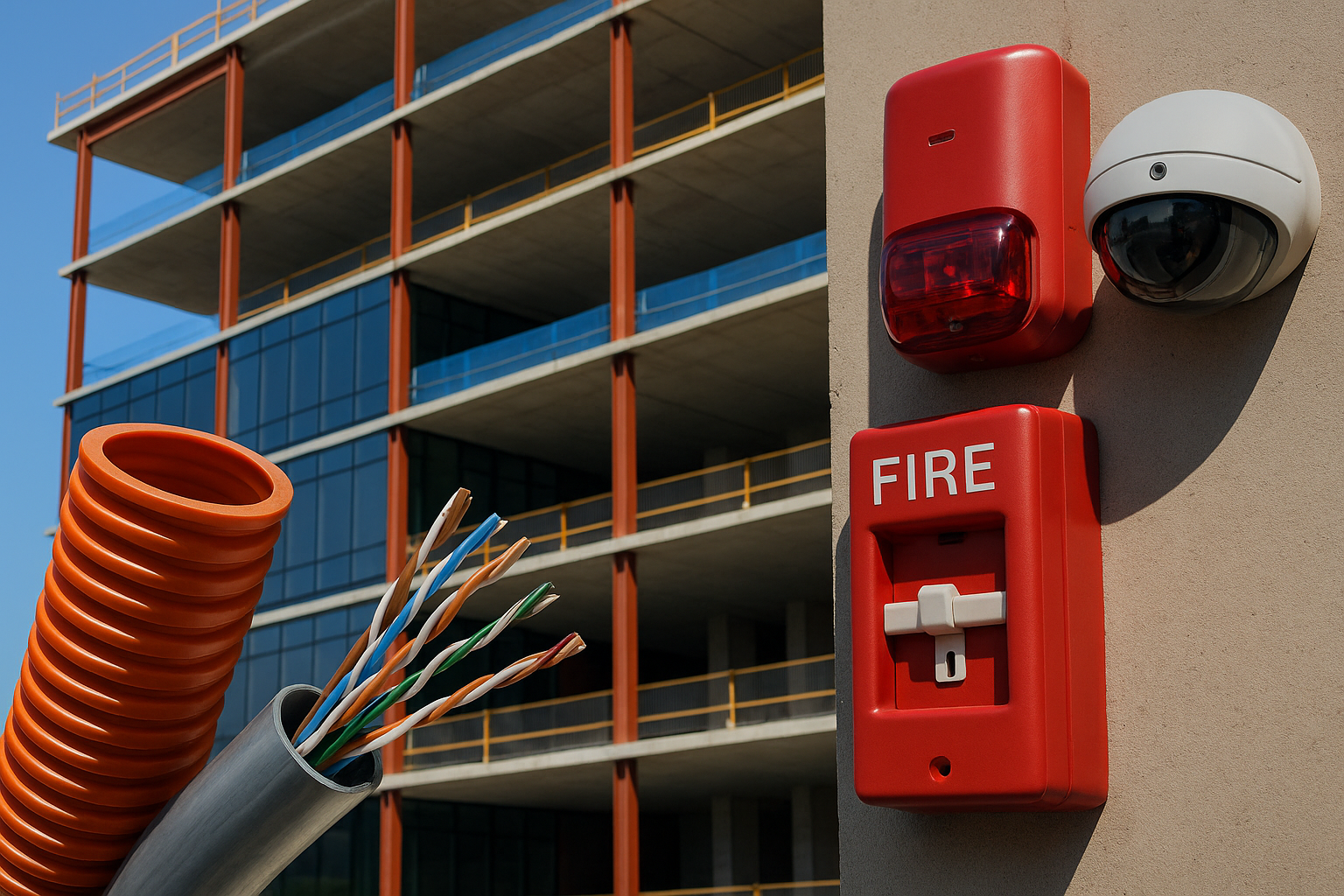
Wisconsin’s Updated Commercial Building Code 2025
Info for subcontractors, general contractors, developers, and business owners
Wisconsin’s Updated Commercial Building Code 2025
Wisconsin’s Updated Commercial Building Code means changes for contractors, developers, general contractors and consumers. This blog post looks at those changes and what that means for you. On October 1, 2025, Wisconsin will adopt a new version of the Commercial Building Code, based on the 2021 ICC codes with state-specific amendments. This change significantly affects systems outlined under Division 27 (communications and low-voltage cabling) and Division 28 (fire alarms, security, and life safety systems).
Whether you’re a subcontractor, general contractor, developer, or business owner, understanding these updates is essential to ensure code compliance, system performance, and long-term reliability.
Division 27: Structured Cabling & Communications Infrastructure
Key Updates:
- New performance standards for fiber optic testing, including reflection index requirements.
- Clarification on loose-tube vs. loose-buffer fiber.
- Removal of obsolete performance metrics like PSACR.
- Requirement for digitally signed record drawings (no more paper closeout docs).
- PoE cabling must now support 802.3bt PoE++ (up to 90W), essential for cameras, WAPs, and smart building tech.
- Textile-based innerduct accepted as a valid method for cable routing.
🔗 Explore our Structured Cabling Services
What These Code Updates Mean for You:
For the industry, these updates raise the bar for network infrastructure—encouraging futureproof designs, digital documentation, and improved PoE performance. For end-users, this means faster, more reliable internet, better performance for smart devices, and less downtime for critical systems like phones, AV, and Wi-Fi. Consumers can expect smarter buildings with more consistent technology experiences.
These changes reinforce the need for future-ready infrastructure. Contractors and business owners will need to plan for higher wattage demands, especially in PoE-powered surveillance, AV, or signage applications. Digital documentation improves transparency and long-term maintenance efficiency. Newport Network Solutions can help you design and install cabling systems that meet the updated standards with room for scalability.
Division 28: Fire Alarm and Security System Enhancements
Key Updates:
- Modernized requirements for fire alarm layouts, symbols, and system testing.
- Fire alarm and security systems must be installed to integrate cleanly with new cabling standards.
- Introduction of emergency responder radio coverage systems (ERRCS) as their own spec section.
- Updates to video surveillance and access control systems, aligning with federal and UL performance criteria.
- New commissioning requirements for safety systems.
🔗 See Our Security System Capabilities
🔗 Fire Alarm Installation & Monitoring
What These Code Updates Mean for You:
For the industry, this ensures tighter integration between safety systems and network design. For consumers—tenants, employees, and visitors—these changes mean safer buildings, faster emergency response, and better protection through updated surveillance and access control technology. The systems are not only more advanced but also more dependable.
With higher integration between life safety systems and low-voltage cabling, it’s more critical than ever to coordinate security and fire alarm installations with structured cabling plans. These upgrades ensure better emergency response performance and reduce the chance of failed inspections due to outdated specs.
Stakeholder Guide: What You Need to Know About Wisconsin’s Updated Commercial Building Code 2025
For Subcontractors & Low-Voltage Technicians
You’ll need to:
- Use fiber and PoE components certified for 2021 ICC standards.
- Incorporate textile innerduct and digitally deliver record drawings.
- Meet specific termination, labeling, and coordination standards across Division 27/28.
🔗 Partner with Newport Network Solutions
What This Means for You:
Failing to meet these standards can result in failed inspections, costly rework, or delays. Partnering with a compliant low-voltage provider ensures you stay ahead of code enforcement and specification shifts.
Professionals installing Division 27/28 systems must now deliver higher standards for installation, documentation, and testing. Consumers ultimately benefit from cleaner installs, clearer labeling, and fewer system failures, creating a smoother tech experience from day one.
For General Contractors
You must:
- Ensure subcontractors submit plans aligned with the new 2025 code.
- Verify Division 27 and 28 installations are coordinated and code-matched.
- Plan for enhanced PoE and fire/life safety commissioning requirements.
What This Means for You:
General contractors will be expected to take ownership of Division 27/28 alignment during design-build and plan submission. Ensuring your subcontractors are up-to-date is vital to keeping projects on track.
For GCs, the shift reinforces cross-trade coordination and compliance. But on the consumer side, the result is better building performance, fewer handoff issues, and greater confidence in the technology that supports day-to-day operations, safety, and convenience.
For Developers and Business Owners
Prepare to:
- Submit plans post-October 1 that include high-performance cabling and modern security/fire systems.
- Budget for updated infrastructure: PoE++ switches, ERRCS, AV backbones, etc.
- Design for digital as-builts and scalable network infrastructure.
🔗 Technology Infrastructure Planning
What This Means for You:
Developers and business owners benefit from future-ready buildings, increased resale value, and reduced tenant complaints due to poor tech infrastructure. But only if your system is properly scoped under the new code. The 2025 code updates mean earlier coordination with technology consultants and a greater responsibility to integrate structured cabling, security, and life safety systems into the initial design and permitting phases.
These changes help futureproof properties, reduce rework, and improve code compliance, while also enhancing the building’s marketability. For tenants and end-users, these upgrades result in safer, more connected, and more intelligent spaces—with properly installed systems that actually work as intended from day one.
Your Next Steps Before October 1, 2025
Wisconsin’s Updated Commercial Building Code 2025 can be addressed by following the next steps outlined below.
| ✅ Task | 🛠 Action |
| Check Permit Timelines | File plans under the 2015 code by Sept 30, or under new 2025 version after |
| Review Specs | Read the updated Division 27/28 MasterFormat guidelines |
| Plan Cabling | Ensure PoE++, fiber backbone, labeling, and testing specs are met |
| Verify Drawings | Switch to digitally signed PDFs for all record submissions |
| Coordinate Trades | Ensure fire alarm, security, and cabling are designed together |
Next Steps to Ensure Compliance – Expanded
To ensure full compliance with Wisconsin’s updated Commercial Building Code (effective October 1, 2025), especially regarding Division 27 and Division 28 systems, contractors, developers, and general contractors should take the following steps:
✅ 1. Review the Updated Code Thoroughly
-
Obtain and read the 2025 Wisconsin Commercial Building Code in detail.
-
Pay particular attention to Division 27 (Communications Systems) and Division 28 (Electronic Safety and Security) sections.
✅ 2. Consult Qualified Low-Voltage and Fire Protection Experts
-
Work with subcontractors like who specialize in structured cabling, fire alarms, fiber optics, and security systems and stay current with evolving code requirements.
✅ 3. Coordinate Early in the Design Phase
-
Ensure your engineers, architects, and subcontractors are collaborating early in the planning process.
-
Verify that plans for systems like voice/data, video surveillance, access control, and fire alarms are code-compliant before permitting.
✅ 4. Update Specifications and Construction Documents
-
Revise construction drawings and specifications to reflect code updates, particularly related to:
-
Fire alarm notification and detection zones
-
Low-voltage cable fire ratings and support
-
Pathways and access for future systems expansion
-
✅ 5. Schedule a Code Compliance Review
-
Conduct a pre-construction compliance review or peer review with an engineer or firm familiar with the new code.
-
Ask the local Authority Having Jurisdiction (AHJ) about any regional interpretations or enforcement nuances.
✅ 6. Train Your Staff
-
Ensure field technicians and project managers are trained on new requirements—especially installation methods, labeling, and inspection readiness.
✅ 7. Communicate with Inspectors
-
Stay in touch with building officials and inspectors during key milestones. Document progress and obtain approval for inspections as required by the revised code.
✅ 8. Plan for Consumer-Facing Impacts
-
Ensure that the systems you’re installing will meet not only code, but also end-user expectations for functionality, safety, accessibility, and future scalability.
Here are authoritative links for accessing Wisconsin’s updated Commercial Building Code and related Division 27 specifications:
-
Wisconsin’s Commercial Building Code (SPS Chapters 361–366) – The complete, up-to-date commercial building code is published online and updated monthly by the Wisconsin Legislature:
[Wisconsin Commercial Building Code (SPS 361–366)] Wisconsin Legislative Documents -
Wisconsin’s Division 27 Communications Master Specifications – Published on the State of Wisconsin Department of Administration website, this includes the latest updates (as of September 3, 2024) to Division 27, including detailed revisions for structured cabling, fiber optics, innerduct usage, PoE, label protocols, and commissioning requirements:
[Division 27 – Communications (Master Specs & Revision History)] WI DOA Div 27 Master Spec - Wisconsin DOA Master Spec – Division 28 (Electronic Safety and Security)
This page provides downloadable files including all specification sections (like fire alarm systems, video surveillance, access control, commissioning, and ERRCS) along with their revision dates, current as of September 3, 2024. WI DOA Div 28 Master Spec
These resources are issued by trusted state agencies—the Legislative Reference Bureau for building codes and the DOA Facilities Development Division for master specifications—so you can rely on them for accurate, official guidance.
Why Newport Network Solutions Stands Out in Wisconsin
With Newport Network Solutions, you’re not just hiring a subcontractor—you’re gaining a Division 27 & 28 partner who understands:
- The full construction lifecycle
- Code compliance and testing
- Scope coordination with other trades
- Owner turnover requirements and expectations
Based in New Berlin WI with an office in Madison, WI:
🌐 Visit us online:
🔗 Connect on LinkedIn:
linkedin.com/company/newport-network-solutions
📞 Contact us today to review your project or request a quote:
Contact: Adrian Crabb – Business Development Manager
Phone: 608-572-2654
Email: adrian@newportnetworksolutions.com
Ready to hire a code-compliant division 27 & 28 subcontractor in Madison, Milwaukee and Beyond?
Let’s talk about your unique needs and discuss how we can partner on your upcoming builds.
Contact: Adrian Crabb, Business Development Manager
Email: adrian@newportnetworksolutions.com
Phone: 608-572-2654
GET A QUOTE
"*" indicates required fields